
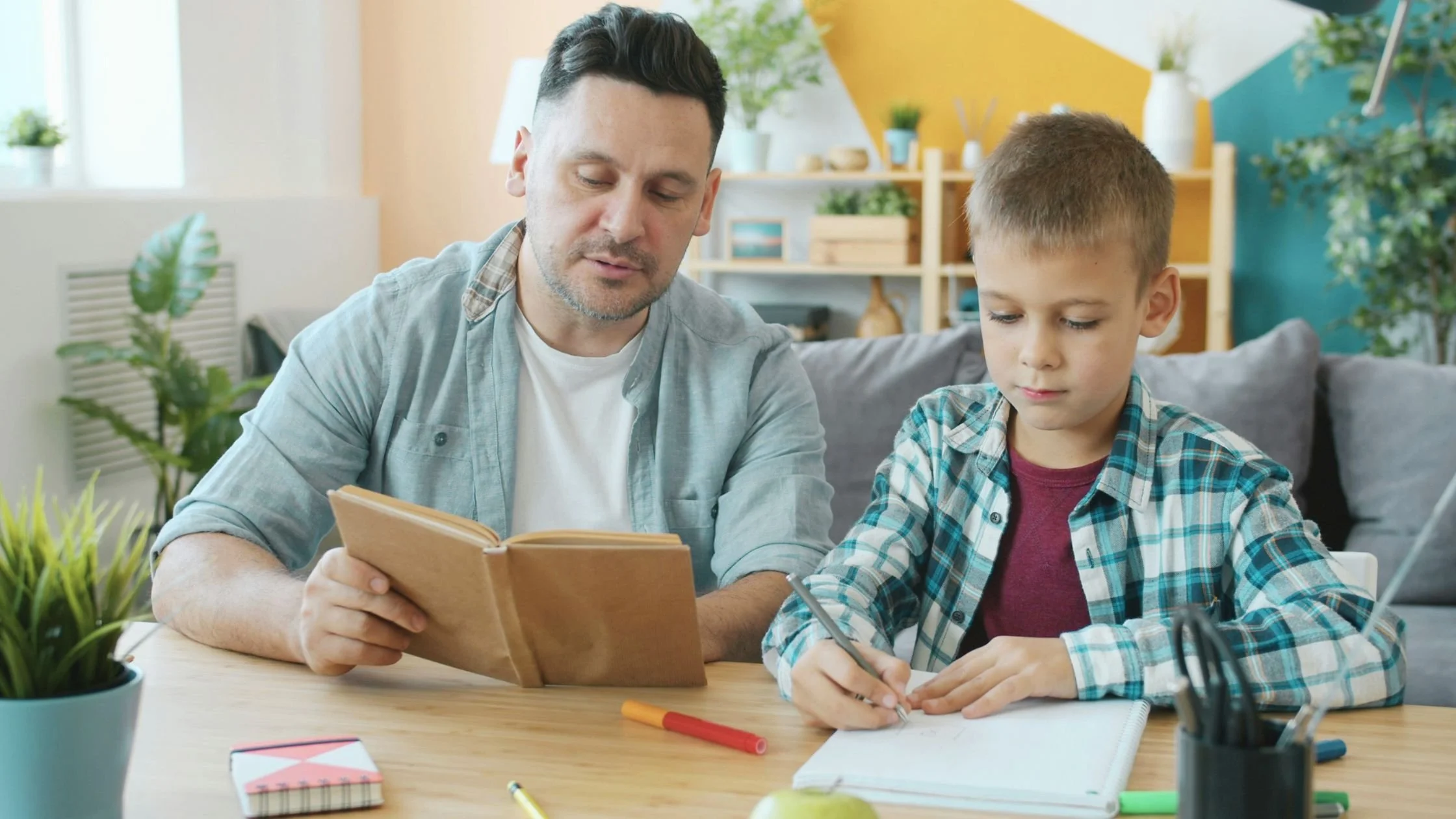
Creative ways to help your child study effectively and become a more independent learner
The first few weeks of school bring plenty of excitement: new teachers, fresh supplies, different routines, and new subjects to explore. Before long, however, the first round of quizzes and tests arrives.
For many students, studying means rereading a study guide, looking through class notes, or asking a parent to quiz them. Although these strategies can help, they are often less effective than they seem. A child may read the same page five times and feel familiar with the information without being able to recall it independently during a test.
This can be especially frustrating for students with dyslexia. Reading may already require a great deal of concentration and energy. Simply asking a child to read the same material again can lead to fatigue without necessarily improving understanding or memory.
Effective studying requires students to do something with the information. They need to say it, retrieve it, organize it, visualize it, connect it to something familiar, or apply it in a new way. In other words, studying should be active rather than passive.
There is another important goal, too: good study skills should gradually make adults less necessary.
When children are young, parents and teachers naturally provide plenty of support. We remind them what to study, help them make flashcards, ask questions, and identify what they still need to learn. As students get older, however, we want them to develop strategies they can use on their own.
If you are looking for effective study techniques for children, especially children with dyslexia or other reading challenges, these seven ideas are a great place to start. They are practical, flexible, and easy to adjust based on your child’s age and learning needs.
1. Study Out Loud
Turn passive reading into active explanation.
Reading something silently can make it look familiar without requiring the brain to retrieve much information. Instead of asking your child to read the material repeatedly, encourage them to close the book and explain what they remember out loud.
Your child could pretend to teach a class, explain a science concept to the family dog, or tell you everything they remember about a chapter during dinner. They might even record a short “lesson” on a phone or tablet and listen to it later.
If your child gets stuck, let them check their notes. Then, ask them to close the notes and try again. This process of retrieving information, checking it, and retrieving it again strengthens memory more effectively than simply rereading the page.
Encourage your child to use their own words instead of repeating the textbook word for word. When students explain an idea in language that feels natural to them, they have to think about what the information actually means. As a result, they are more likely to understand and remember it.
This strategy can be particularly helpful for students with dyslexia because it reduces the amount of repeated reading required. It also gives them a chance to demonstrate knowledge without spelling, handwriting, or decoding getting in the way.
Parent tip: Instead of asking, “Do you want me to quiz you?” say, “Teach me what you learned about photosynthesis.” At first, your child may need an audience. Over time, encourage them to explain the material aloud independently.
2. Walk While You Memorize
Use movement to make repetition more engaging.
Some children remember information better when their bodies are involved in the learning process. If sitting still makes it harder for your child to focus, movement may help.
Try having your child walk around the house while reciting vocabulary definitions, multiplication facts, historical dates, spelling patterns, or the steps in a process. They could also bounce a ball, march, tap a rhythm, or pace back and forth while saying the information aloud.
Movement is especially helpful for material that requires repetition. Instead of asking a restless child to sit at a desk and stare at a study guide for 30 minutes, put some of that energy to work.
You can also match a movement to a specific answer. For example, your child might take one step for each part of a definition or use a different motion for each stage of the water cycle. The movement provides an additional cue that may make the information easier to recall later.
However, the activity should support learning rather than become a distraction. Start with simple, repetitive movements and see what works best for your child.
Among the many creative study strategies for students, this one is especially easy to try. It requires no special supplies, and your child can use it almost anywhere.
3. Put Information on Your Fingers
Create a portable reminder for short lists and sequences.
Need to remember five important facts? Your child already has a study tool available.
Assign one fact to each finger. Ask your child to touch the first finger while saying the first fact, then move to the next finger and fact. Repeat the sequence several times until your child can work through all five without looking at their notes.
This technique works particularly well for information that needs to be remembered in order. Your child could use it for the steps in a scientific process, the parts of a paragraph, categories of animals, stages of a historical event, or a short list of important facts.
For example, if your child needs to remember five parts of a story, each finger could represent one element: characters, setting, problem, events, and solution. During the test, touching or visualizing each finger may help prompt the next answer.
You can also adapt the strategy for fewer than five items or use both hands for a longer list. Still, try to keep the information manageable. If each finger represents a long paragraph, the technique may become confusing.
Even better, your child’s “study tool” will still be available when they sit down to take the test.
4. Draw the Answer
Use simple pictures to organize and remember information.
Studying does not always have to involve more words. In fact, asking a student with dyslexia to produce page after page of written notes may create extra work without improving learning.
Instead, encourage your child to turn information into a quick picture, diagram, timeline, symbol, map, or cartoon. A student studying the water cycle might draw it. A student learning about a battle might sketch a simple map. A student studying vocabulary could create a tiny picture beside each word.
The drawings do not need to be beautiful or detailed. Stick figures, arrows, boxes, and quick symbols work perfectly well. In fact, funny or exaggerated drawings can sometimes be easier to remember than realistic ones.
The important part is deciding, “How could I represent this information visually?” That question requires your child to identify the most important ideas and think about how they relate to one another. This involves much more mental effort than simply copying a sentence from a book.
After your child finishes the drawing, ask them to explain it aloud. Combining visual representation with spoken explanation can make the activity even more effective.
Later, your child can cover the labels and try to fill them in from memory. This turns the drawing into a simple, reusable self-quiz.
5. Make a Ridiculous Association
Connect new information to something funny or surprising.
Our brains tend to remember things that are unusual, funny, exaggerated, or unexpected. Therefore, if your child needs to connect two pieces of information, encourage them to invent a ridiculous mental picture that links them together.
The more ridiculous the image, the better.
Your child might imagine a historical figure riding a giant chicken through the kitchen. They could turn a vocabulary word into a silly scene or picture an enormous object doing something completely impossible.
For example, if your child needs to remember that a peninsula is surrounded by water on three sides, they might picture a giant pen sitting on a piece of land with three enormous waves splashing around it. The connection does not need to make perfect sense to anyone else. It only needs to help your child remember the information.
This strategy can also help with names, dates, foreign-language vocabulary, scientific terms, and spelling patterns. Encourage your child to make the image vivid by adding color, sound, movement, or humor.
These associations may seem goofy, but that is exactly the point. A strange mental picture is often easier to retrieve than another line of text on a study guide.
When your child laughs and says, “That is so weird,” you may have found an excellent memory trick.
6. Try a Brain Dump
Find out what your child truly knows without giving clues.
A brain dump is one of the best ways to discover whether a student is actually ready for a test.
Give your child a blank sheet of paper. Without looking at notes, books, or study guides, ask them to write, draw, or map everything they can remember about the material.
For a child who finds handwriting difficult, allow them to type, use a speech-to-text tool, record their answers, or explain the information aloud while you take notes. The goal is to test memory and understanding—not handwriting speed or spelling accuracy.
After your child finishes, let them open their notes and compare.
What did they remember? What did they leave out? What did they confuse? Which details need more practice?
The missing or incorrect information becomes the new study list. Consequently, your child can spend time reviewing what they do not know instead of repeatedly studying material they have already mastered.
This strategy also helps build independence because a student does not need a parent standing nearby and asking every question. A blank sheet of paper can do the quizzing.
After another round of review, encourage your child to complete a second brain dump. Watching the blank page fill with more accurate information can provide a clear sense of progress and build confidence.
If you are wondering how to help your child study independently, this is one of the most useful strategies to teach. Eventually, your child can complete the entire process alone: recall the material, check the notes, identify gaps, and decide what to study next.
7. Change Locations for the Hardest Material
Create extra memory cues by changing the environment.
When a fact or concept simply will not stick, try changing the environment.
Study one difficult concept at the kitchen table. Take another to the porch. Review a third while standing near the stairs. Practice the hardest vocabulary words while walking to the mailbox.
Different locations can create additional memory cues. During the test, your child may think, “Oh! That is the one I studied on the porch,” and remember the conversation, picture, or movement connected to that place.
You can make the locations more meaningful by matching them to the subject. For example, study plant vocabulary outside, review measurements in the kitchen, or practice map skills near a globe. These connections can make abstract information feel more concrete.
However, you do not need to turn the entire house into a study station. Save this strategy for stubborn facts or concepts that are not sticking through ordinary review. Otherwise, moving from place to place may become distracting or take too much time.
The purpose is not simply to change seats. Instead, the goal is to give difficult information a memorable context.
The Goal: “I Know How to Study”
Help your child build a toolbox of strategies that encourages independence.
The best study strategy will vary from student to student—and even from one test to another. Memorizing vocabulary may call for movement and ridiculous associations. Understanding a complicated science concept may become easier when a student draws it and explains it aloud. Preparing for a history test might end with a brain dump to reveal what the student has truly learned.
Students with dyslexia often work incredibly hard. Therefore, they deserve study methods that make that effort productive. The goal is not to find one perfect technique or require your child to use every idea on this list. Instead, try one strategy at a time and notice what helps.
Ask your child questions such as:
Which strategy made the information easier to remember?
Which one helped you understand the lesson?
Which strategy could you use without my help?
What might work better for the next test?
These conversations teach children to think about how they learn. That awareness is an important step toward independence.
The goal is not for parents to become expert quiz-givers. Likewise, it is not for teachers to constantly tell students exactly how to prepare. The goal is for children to build a flexible toolbox of effective study techniques they can choose from.
At first, your child may need reminders and encouragement. You might suggest drawing a diagram, starting a brain dump, or teaching the lesson aloud. Gradually, however, you can step back.
A child might begin by studying out loud with a parent, then practice by explaining the lesson to a pet, and eventually review the material alone. Similarly, a parent may initially help check a brain dump before the student learns to compare it with their notes independently.
Progress does not have to happen all at once. Even small steps matter.
When a child can look at tomorrow’s test and ask, “How am I going to learn this? Which strategy should I use? How can I tell when I really know it?” something important has changed.
They are no longer simply trying to finish a study guide or memorize enough information to pass a test. They are beginning to understand how their own brain learns best.
They are not just learning the material anymore.
They are learning how to learn.


